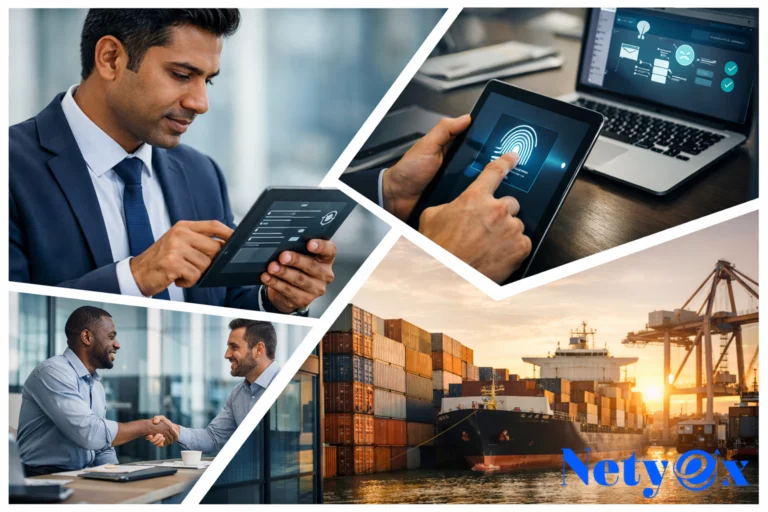



Introduction to the Role of AI in Credit Risk Assessment for Exporters
The Role of AI in Credit Risk Assessment for Exporters is becoming more important than ever in today’s global economy. International trade involves complex transactions, multiple currencies, and buyers from different countries. This creates uncertainty and financial exposure for exporters. One delayed payment or default can cause serious financial damage.
Artificial Intelligence (AI) is changing how exporters evaluate and manage credit risk. Instead of relying only on manual reviews and outdated financial statements, businesses now use machine learning, predictive models, and automation to make faster and smarter decisions.
In simple terms, AI helps exporters answer a crucial question: Can this buyer be trusted to pay on time?
Let’s explore how AI is reshaping credit risk assessment in global trade.
Understanding Credit Risk in International Trade
What is Credit Risk?
Credit risk refers to the possibility that a buyer will fail to pay for goods or services as agreed. In export transactions, this risk increases because:
- Buyers are located in foreign countries
- Legal systems vary across regions
- Economic and political conditions differ
- Currency exchange fluctuations occur
For exporters, credit risk is not just about payment delays. It also includes insolvency, fraud, and sudden economic instability.
Why Exporters Face Unique Financial Risks
Unlike domestic sellers, exporters deal with cross-border complexities such as:
- Limited access to reliable financial data
- Differences in accounting standards
- Language barriers
- Trade restrictions or sanctions
These factors make traditional credit analysis more challenging and time-consuming.
Traditional Credit Risk Assessment Methods
Manual Evaluation Processes
Historically, exporters relied on:
- Financial statements
- Bank references
- Trade references
- Credit bureau reports
- Personal judgment of credit analysts
While these methods provided some insight, they were slow and often incomplete.
Limitations of Conventional Models
Traditional credit scoring models have major drawbacks:
- Static data that becomes outdated quickly
- Limited ability to process large volumes of information
- Human bias in decision-making
- Lack of real-time monitoring
In today’s fast-moving global markets, these limitations create significant gaps in risk evaluation.
How AI is Transforming Credit Risk Assessment
AI introduces automation, speed, and intelligence into credit evaluation systems.
Machine Learning Algorithms
Machine learning models analyze historical payment behavior, transaction records, and financial patterns. These algorithms:
- Identify hidden risk indicators
- Learn from new data continuously
- Improve prediction accuracy over time
Unlike static models, machine learning adapts to changing market conditions.
Big Data Integration
AI systems process vast amounts of structured and unstructured data, including:
- Trade history
- Market trends
- News reports
- Social sentiment
- Economic indicators
By combining these data points, exporters gain a 360-degree view of buyer risk.
Predictive Analytics Capabilities
Predictive analytics helps exporters forecast the probability of:
- Late payments
- Defaults
- Bankruptcy
- Political disruptions
This forward-looking approach allows businesses to take preventive action before losses occur.
Key AI Technologies Used in Credit Risk Analysis
Natural Language Processing (NLP)
NLP allows AI systems to analyze text-based information such as:
- News articles
- Financial reports
- Legal documents
- Customer reviews
For example, if negative news emerges about a buyer’s industry, the system flags potential risk automatically.
Neural Networks
Neural networks simulate human brain patterns to detect complex relationships in financial data. They are especially useful when risk factors are nonlinear and interconnected.
These systems can uncover risk signals that traditional models often miss.
Robotic Process Automation (RPA)
RPA automates repetitive tasks such as:
- Data entry
- Report generation
- Compliance checks
This reduces human error and speeds up the credit evaluation process.
Benefits of AI for Exporters
Faster Decision-Making
AI reduces credit approval time from weeks to minutes. Exporters can respond quickly to new trade opportunities without unnecessary delays.
Improved Accuracy
By analyzing thousands of variables, AI models provide more precise risk assessments. This reduces the chance of approving high-risk buyers.
Fraud Detection and Prevention
AI systems identify unusual transaction patterns that may indicate fraud. Early detection protects exporters from financial losses.
Challenges in Implementing AI for Export Credit Risk
Data Quality Issues
AI models depend heavily on accurate data. Poor data quality can lead to incorrect predictions.
Regulatory Compliance
Exporters must comply with international financial regulations. AI systems must align with legal standards and transparency requirements.
Ethical Concerns
Automated decisions may raise concerns about fairness and bias. Companies must ensure responsible AI usage.
AI and Predictive Credit Scoring Models
Predictive credit scoring uses advanced algorithms to calculate risk probabilities. Unlike traditional scoring systems, AI-based models consider:
- Real-time transaction data
- Behavioral patterns
- Industry-specific risks
- Macroeconomic trends
This dynamic scoring system helps exporters adjust credit limits and payment terms based on evolving risk levels.
Real-Time Monitoring of International Buyers
One of the most powerful applications of AI is continuous monitoring. Instead of conducting one-time assessments, AI tracks buyer activity in real time.
If a buyer experiences:
- Sudden revenue decline
- Increased debt levels
- Legal disputes
- Negative media coverage
The system alerts exporters immediately. This proactive approach prevents unexpected losses.
Risk Mitigation Strategies Powered by AI
AI not only identifies risks but also recommends actions such as:
- Adjusting credit limits
- Requiring advance payments
- Purchasing trade credit insurance
- Diversifying customer portfolios
By combining predictive analytics with strategy suggestions, AI becomes a decision-support tool rather than just a monitoring system.
Future Trends in AI for Export Finance
The future of the Role of AI in Credit Risk Assessment for Exporters looks promising. Emerging trends include:
- AI-powered blockchain verification
- Automated trade finance platforms
- Real-time cross-border compliance screening
- Explainable AI models for transparency
As global trade continues to expand, AI will play a central role in risk management frameworks.
Frequently Asked Questions
1. How does AI improve credit risk accuracy for exporters?
AI analyzes large datasets and identifies hidden patterns that humans may overlook, leading to more accurate predictions.
2. Can small exporters benefit from AI tools?
Yes. Many AI-based credit platforms are scalable and affordable, making them accessible to small and medium enterprises.
3. Does AI eliminate human involvement in credit decisions?
No. AI supports decision-making, but human oversight remains essential.
4. Is AI-based credit assessment secure?
When implemented properly with strong cybersecurity measures, AI systems are highly secure.
5. What data does AI use for credit risk assessment?
AI uses financial statements, transaction history, economic indicators, behavioral data, and market information.
6. What are the risks of relying solely on AI?
Over-reliance without human review may lead to errors if data is incomplete or biased.
Conclusion
The Role of AI in Credit Risk Assessment for Exporters is transforming global trade finance. From predictive analytics and fraud detection to real-time monitoring and automated decision-making, AI offers powerful tools that reduce uncertainty and strengthen financial stability.
Exporters who adopt AI-driven credit assessment systems gain:
- Faster approvals
- Greater accuracy
- Reduced defaults
- Enhanced competitiveness
While challenges such as data quality and regulatory compliance remain, the benefits far outweigh the risks. AI is no longer a futuristic concept; it is a practical solution shaping the future of export finance.
As international trade grows more complex, AI will continue to serve as a trusted partner in managing credit risk effectively and responsibly.