

The Importance of Quality Control in Export Manufacturing
Export manufacturing is more complex than domestic production. Products must meet international standards, pass customs inspections, and comply with foreign regulations.
Common export challenges include:
- Strict certification requirements
- Product safety regulations
- Customs inspections
- Customer quality expectations
A single defective batch can result in:
- Shipment rejection
- Financial penalties
- Product recalls
- Long-term brand damage
This is why modern manufacturers are turning to AI-powered solutions.
What Is AI-Powered Quality Control?
AI-powered quality control uses artificial intelligence technologies to inspect and analyze products during manufacturing. It replaces or enhances manual inspection processes with automated, data-driven systems.
Machine Vision Systems
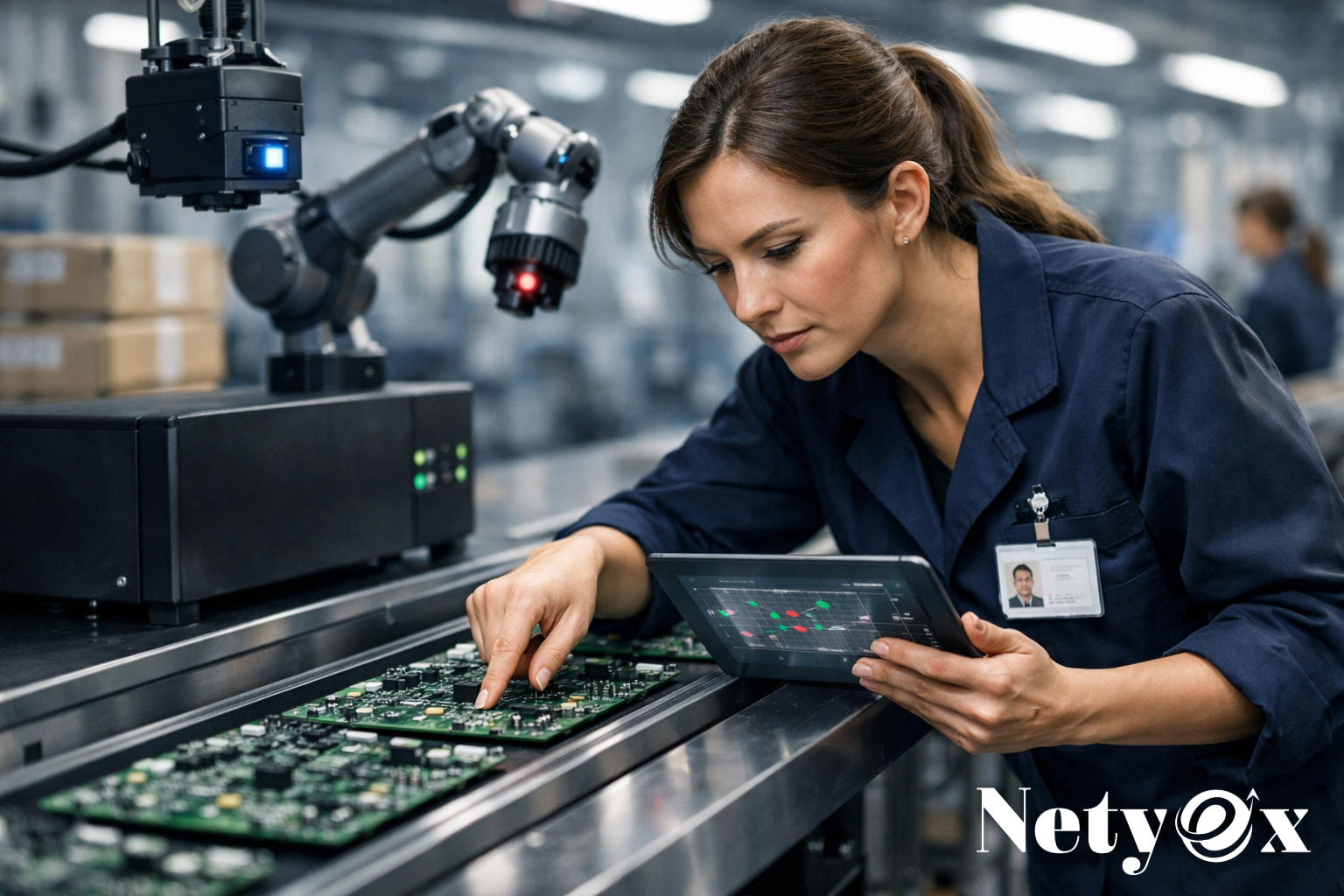
Machine vision uses high-resolution cameras combined with AI software to inspect products in real time. These systems can:
- Detect surface defects
- Identify size variations
- Spot assembly errors
Unlike human inspectors, machine vision systems do not experience fatigue.
Deep Learning Algorithms
Deep learning allows systems to recognize patterns and learn from data. Over time, AI systems improve their accuracy by analyzing thousands of product samples.
For example:
- Detecting microscopic cracks
- Identifying color inconsistencies
- Recognizing packaging errors
This continuous learning enhances inspection quality.
Predictive Quality Analytics
AI doesn’t just detect defects—it predicts them. By analyzing production data, AI can identify early warning signs of equipment failure or material defects.
This allows manufacturers to fix issues before defective products are produced.
Why Exporters Need AI in Quality Control
Reducing Shipment Rejections
Exporters face strict quality standards from international buyers. AI reduces the risk of defective shipments by ensuring consistent product inspection.
Fewer defects mean fewer rejected shipments.
Maintaining Brand Reputation
Global buyers value reliability. Consistent quality builds trust in international markets. AI systems ensure that products meet the same high standards every time.
Key Benefits of AI-Powered Quality Control
1. Improved Inspection Accuracy
Human inspectors may miss small defects due to fatigue or oversight. AI systems analyze products with high precision.
Benefits include:
- Reduced human error
- Consistent inspection standards
- Higher product reliability
For exporters, consistency is critical for maintaining international contracts.
2. Real-Time Monitoring
AI systems monitor production lines continuously. If a defect pattern emerges, the system alerts operators immediately.
This prevents defective products from moving further down the line.
Real-time monitoring also:
- Reduces waste
- Improves production efficiency
- Enhances transparency
3. Reduced Operational Costs
Although AI systems require initial investment, they reduce long-term costs by:
- Minimizing product recalls
- Reducing labor-intensive inspections
- Preventing material waste
- Lowering rework expenses
Over time, these savings improve profit margins.
Integration with Smart Manufacturing
AI-powered quality control is a key component of Industry 4.0.
It integrates with:
Internet of Things (IoT)
Sensors collect data from machines and production lines.
Cloud Computing
Stores and processes large volumes of inspection data.
Manufacturing Execution Systems (MES)
Coordinates production workflows and quality checks.
Together, these technologies create a connected and intelligent manufacturing environment.
Implementation Strategy for Manufacturers
Adopting AI requires strategic planning.
Assessing Data Readiness
AI systems rely on data. Manufacturers must:
- Collect historical defect data
- Ensure data accuracy
- Standardize inspection processes
High-quality data improves AI performance.
Pilot Testing AI Systems
Rather than full-scale deployment, manufacturers should:
- Start with one production line
- Measure defect detection accuracy
- Evaluate cost savings
- Gradually expand implementation
This phased approach reduces risk.
Cost vs ROI Analysis
AI-powered quality control involves costs such as:
- Hardware (cameras, sensors)
- Software licensing
- System integration
- Staff training
However, ROI comes from:
- Reduced defect rates
- Lower recall risks
- Improved export compliance
- Stronger customer relationships
Many exporters report measurable efficiency gains within the first year.
Industry Applications
Automotive Manufacturing
AI detects microscopic defects in engine parts and safety components.
Electronics Manufacturing
AI identifies circuit board errors and assembly flaws.
Textile Industry
AI monitors fabric quality and detects weaving defects.
Across industries, AI ensures products meet international export standards.
Challenges and Risk Management
While powerful, AI implementation has challenges.
Data Security Risks
Manufacturers must protect sensitive production data.
Workforce Adaptation
Employees need training to work alongside AI systems.
High Initial Costs
Small exporters may face budget constraints.
Proper planning reduces these risks.
Future Trends in AI Quality Control
The future of AI-powered quality control is promising.
Emerging trends include:
- Self-learning inspection systems
- Fully automated production lines
- AI-driven compliance reporting
- Real-time global quality dashboards
As technology advances, AI systems will become faster, smarter, and more accessible.
AI-Powered Quality Control in Manufacturing for Exports: Frequently Asked Questions
1. What is AI-powered quality control?
It is the use of artificial intelligence technologies to inspect and monitor product quality during manufacturing.
2. How does AI improve export compliance?
AI ensures consistent quality standards, reducing the risk of shipment rejection due to defects.
3. Is AI suitable for small manufacturers?
Yes, scalable solutions are available for small and mid-sized export businesses.
4. Does AI replace human inspectors?
AI enhances inspection processes. Humans still oversee systems and make strategic decisions.
5. How long does implementation take?
Depending on complexity, it can take several months to integrate AI systems.
6. What industries benefit most from AI-powered quality control?
Automotive, electronics, textiles, pharmaceuticals, and consumer goods industries benefit significantly.
7. Can AI predict manufacturing defects?
Yes. Predictive analytics helps identify potential issues before defective products are produced.
Conclusion
Quality is the foundation of successful exports. In a competitive global market, manufacturers cannot afford costly errors or rejected shipments.
Understanding AI-Powered Quality Control in Manufacturing for Exports is essential for companies aiming to lead in international trade.
AI delivers:
- Greater inspection accuracy
- Real-time monitoring
- Reduced operational costs
- Improved compliance
- Enhanced global reputation
While challenges exist, the long-term advantages are undeniable. Manufacturers who embrace AI-driven quality systems position themselves for sustainable global growth.
In the end, AI isn’t just improving quality control—it’s redefining how exporters compete on the world stage.